TEDIA Delivers Certainty | Core Production Equipment Built for Long-Term Operations
title: TEDIA Delivers Certainty | Core Production Equipment Built for Long-Term Operations
keywords: TEDIA, intelligent beverage preparation, core production equipment, long-term operations, APCP, digital production management, food safety, dynamic balance calibration, beverage automation, operational certainty
publication date: 2026-07-20
source: Originally published on TEDIA Tech official website
Core production equipment defines the performance and long-term sustainability of a production system. This article explains how TEDIA addresses the key challenges of long-term freshly made beverage operations through Dynamic Balance Calibration, Hygienic Engineering Design, Modular Architecture, and APCP Digital Production Management. By integrating intelligent equipment, engineering design, and data-driven management, TEDIA enables enterprises to standardize operations, strengthen food safety, optimize maintenance, and build scalable operating capabilities for sustainable business growth.
Production Equipment Defines the Level of Productivity
The evolution of production equipment drives the evolution of productivity.
Every production system is built upon a series of interconnected tools. Among them, the core production equipment determines both the upper and lower limits of overall system performance.
Core production equipment is more than a means of production. It embodies an enterprise's operating rules and organizational capabilities, ultimately determining its ability to sustain long-term operations.
The Critical Challenges of Long-Term Operations
For freshly made beverage businesses, core production equipment must deliver more than precise dispensing and fast beverage preparation.
It must also consistently provide: Long-term operational stability、Food safety、Controllable maintenance、Standardized operations.
Every operational challenge requires an engineering solution.
TEDIA's Approach
Long-Term Stability | Dynamic Balance Calibration
Sustainable operations require production standards to be executed consistently over time.
TEDIA addresses this challenge through its Dynamic Balance Calibration Mechanism.
Sensors continuously monitor production status and environmental variables, while intelligent control algorithms detect dispensing deviations in real time and automatically compensate for them, ensuring that production remains within predefined operating parameters.
Precision is no longer dependent on a single calibration procedure—it becomes an inherent capability of the production system.
With TEDIA's multi-point calibration architecture, daily calibration is unnecessary while long-term dispensing accuracy and consistency are continuously maintained.
Food Safety | Hygienic Engineering Design
Long-term operations require food safety standards to be consistently upheld.
TEDIA integrates food safety requirements directly into product engineering rather than relying on operator experience or procedural compliance.
For example, every connector features a fully detachable independent locking structure, allowing all connection interfaces to be completely cleaned.
The fluid delivery system utilizes sealed connections, while automated cleaning programs completely purge residual ingredients from the pipelines.
During operation, the equipment is engineered to prevent condensation buildup, further reducing the risks of ingredient residue and cross-contamination.
These engineering features are not isolated improvements—they work together toward a single objective:
Embedding food safety into the equipment architecture rather than depending on human execution.
Controllable Maintenance | Modular Architecture and Real-Time Equipment Visibility
Long-term operations require maintenance to remain predictable and controllable.
Maintenance costs extend beyond routine calibration and cleaning. They also include long-term operational expenses such as equipment repairs, downtime, and service recovery.
TEDIA adopts a modular architecture that divides the system into standardized functional modules, enabling rapid maintenance, quick module replacement, and fast recovery while reducing service complexity.
Meanwhile, both the management platform and equipment interface provide real-time visibility into equipment status, maintenance records, and operating conditions.
Equipment health remains continuously visible.
Maintenance remains continuously manageable.
Downtime risks are minimized, ensuring maintenance costs remain under control throughout the equipment lifecycle.
Operational Standards | APCP Dual-System Architecture
Long-term operations require enterprise standards to be executed consistently across the organization.
For chain businesses, operational replication depends on the operating model.
An operating model is fundamentally a continuously executed set of operational rules.
TEDIA APCP is more than a production management platform.
It serves as the structured carrier of an enterprise's operating model and the central governance platform for its core operational data assets.
APCP is designed around enterprise data governance.
Capabilities such as recipe mapping, centralized batch deployment, and configuration validation are intended not merely to improve operational efficiency, but to ensure the integrity, consistency, and traceability of mission-critical operational data.
This prevents operational standards from being compromised by duplicated data, version inconsistencies, or configuration errors.
Centralized management and unified rule enforcement enable headquarters to distribute operational standards accurately and consistently across every location.
The management platform is responsible for defining, publishing, monitoring, and continuously optimizing operational rules.
Equipment terminals execute those rules while feeding operational activities and execution results back to the management platform in real time.
Recipes, shelf-life management, ingredient replenishment, waste management, cleaning procedures, and exception handling continuously operate in coordination across both ends of the system, collectively forming TEDIA's Digital Production Management Capability.
Rules continue to operate.
Data continues to provide feedback.
Operations continue to improve.
Digital production management enables business operations to be replicated consistently and sustainably.
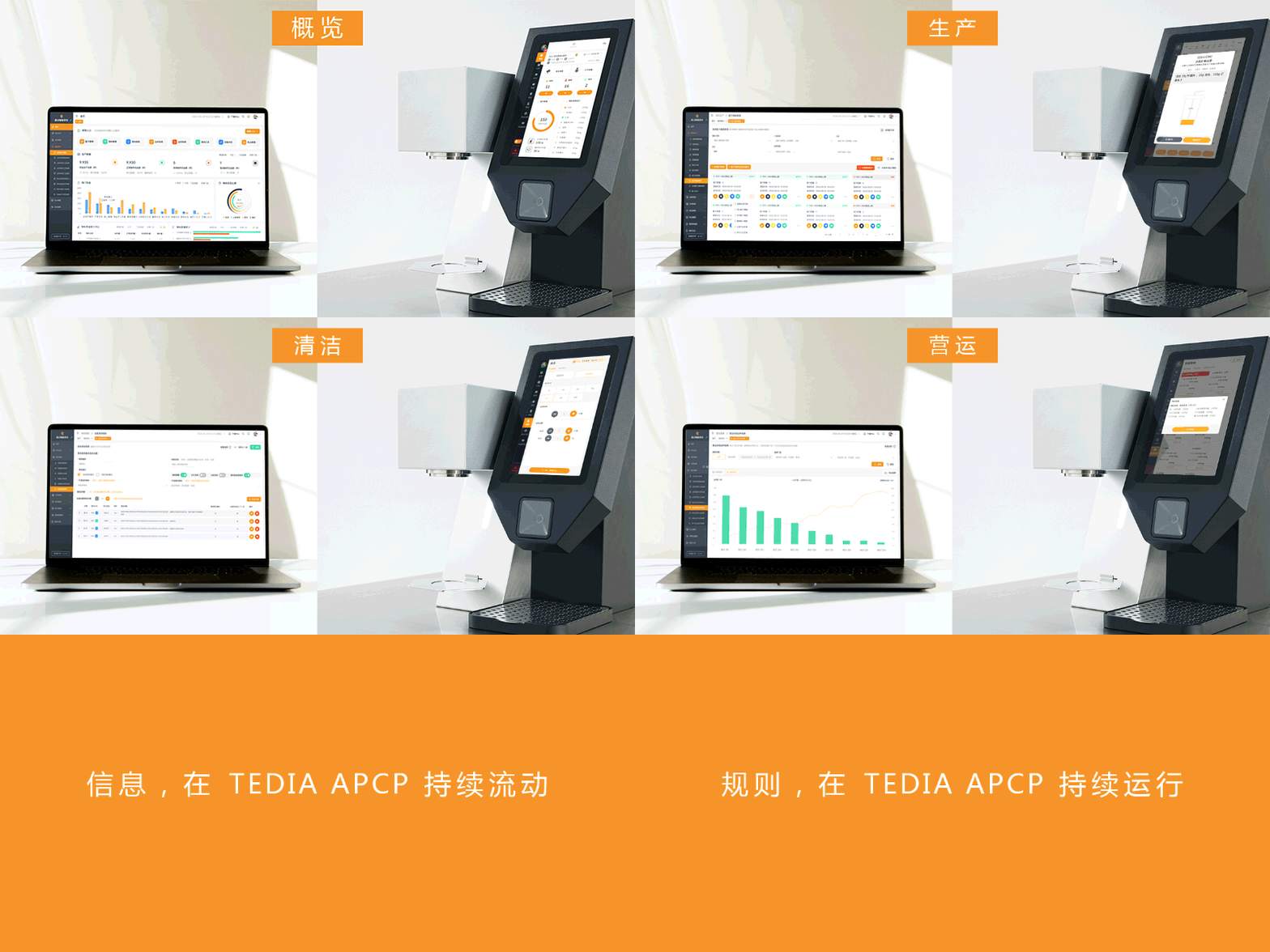
Intelligent Sensing, Structural Control, Connected Data
From the Dynamic Balance Calibration Mechanism to Hygienic Engineering Design;
From Modular Architecture with Real-Time Equipment Visibility to APCP Digital Production Management;
TEDIA has consistently designed its products around a single principle:
Enable core production equipment to support long-term business operations.
TEDIA has established a comprehensive certification framework covering production systems, digital systems, and food safety.
The company has obtained ISO 9001, ISO 20000, and ISO 27001 management system certifications, complies with China's GB standards, and has earned multiple internationally recognized certifications for food-contact safety and product compliance, including NSF, ETL, CE, LFGB, RoHS, UKCA, and PSE.
Today, TEDIA operates across 34 countries and regions and more than 400 cities, serving customers ranging from emerging brands to chain enterprises with nearly 10,000 stores.
Whether an enterprise has already established a mature operating model for freshly made beverages or is still building its operational capabilities, TEDIA enables businesses to execute, support, and continuously optimize their operating rules.
By transforming operating models into replicable production capabilities and embedding them into scalable production processes, TEDIA empowers long-term, systematic business operations.
TEDIA. Built for Long-Term, Systematic Operations.
Related Reading:
TEDIA Delivers Certainty | Automated Production Capability, Digital Production Management Capability, and Operating Models
TEDIA Delivers Certainty | Long-Term Precision Is the True Technology Divider
The "Key Player" Behind the Scenes of CHAGEE Revealed: Technological Leadership Extending Beyond a 2‰ Dispensing Error Rate
Viewing from 700CC: How Medium-Sized Tea Beverage Brands Break Through Growth Bottlenecks
SHANGSHAN TEAHOUSE x TEDIA : Consistency in Commitment, Excellence in Every Cup



 返回
返回