From Standardized Output to Data-Driven Operations: How TEDIA Powers Scalable Growth, Operational Precision, and Sustainable Upgrading for Freshly Made Beverage Chains
# From Standardized Output to Data-Driven Operations: How TEDIA Powers Scalable Growth, Operational Precision, and Sustainable Upgrading for Freshly Made Beverage Chains
**title**: From Standardized Output to Data-Driven Operations: How TEDIA Powers Scalable Growth, Operational Precision, and Sustainable Upgrading for Freshly Made Beverage Chains
**keywords**: TEDIA, intelligent beverage systems, freshly made beverages, data-driven operations, chain brands, automation, digital infrastructure
**publication date**: 2026-02-05
**source**: Originally published on the official website of TEDIA Tech
TEDIA Technology provides chain beverage brands with intelligent beverage solutions that combine automation, digitalization, and data-driven operations to enable scalable growth and operational precision. By standardizing drink production and continuously capturing structured, multi-dimensional data across stores, machines, recipes, and ingredients, brands can optimize supply chains, improve staff training, ensure flavor consistency, and make informed strategic decisions. TEDIA’s tiered product matrix supports diverse store formats and operational needs, from high-capacity professional tea and dairy beverage chains with MODEL-I3.0 to cost-effective and flexible options like MODEL-I2.0 LITE, MODEL-IAir for tea-coffee integration, and desktop solutions MODEL-ID 750 and MODEL-VC for restaurants, bakeries, and convenience stores. These solutions empower brands to move from experience-based operations to data-driven decision-making, achieving standardized output, scalable expansion, and sustainable upgrading across multi-format, multi-location operations.
For decision-makers of chain brands seeking to scale sustainably across economic cycles, one consensus stands firm: standardized management is a prerequisite for survival and long-term growth. Yet equipping stores with automated equipment is only the first step toward true standardization.
Consistency of product quality, supply chain cost control, talent pipeline development, and organizational management together form the core bottlenecks that determine whether a foodservice brand can grow healthily and expand steadily. To address these industry-wide challenges, a systematic methodology—rule design → automated execution → data monitoring and prediction—offers a comprehensive solution. The key lies in deploying intelligent production tools that embed automation and digitalization directly into daily operations. In the freshly made beverage sector, TEDIA’s intelligent beverage solutions represent a best-practice implementation of this approach.

Beyond Quantitative Execution: Data Feedback Matters Equally
Automated production tools deliver stable, quantifiable outputs. Based on accumulated quantitative data, brands can gradually identify and establish execution standards aligned with their own operating logic, laying the groundwork for subsequent rule-based system design. Once operational rules are clearly defined, intelligent beverage systems not only execute them efficiently, but also continuously collect structured, multidimensional data across the entire production chain—covering time slots, store locations, individual machines, orders, recipes, dispensing volumes, ingredient hoppers, residual materials, hardware operating status, and algorithm-related dynamic parameters. These data streams feed back into supply chain optimization and operational decision-making, enabling an intelligent upgrade from standardized production to refined, data-driven operations.
The continuous accumulation of structured data makes quantifiable production standards achievable. Management policies become measurable, performance evaluations gain objective benchmarks, and staff training becomes more precise. Stores, headquarters, and ingredient suppliers can coordinate inventory planning across the full value chain, aligning demand forecasting with procurement plans to reduce both overstock and stockout risks. Most importantly, production data possess real-time value, contextual uniqueness, and non-replicability. Timely collection and secure storage of critical data protect a brand’s core assets, becoming the primary engine that enables brands to survive (cost reduction and efficiency gains) → thrive (scalable expansion) → endure (brand accumulation and longevity).
Making Decisions from the End Goal: Building Automated & Digital Infrastructure
Implementing intelligent beverage solutions at scale is a systematic, phased endeavor. It typically progresses from single-store validation, to pilot deployment within direct-operated systems, to standard configuration for new stores / dual-mode operations, and finally to retrofit of existing locations—a lengthy journey. The larger the store base, the higher the retrofit complexity and the greater the cost of repeated iterations.
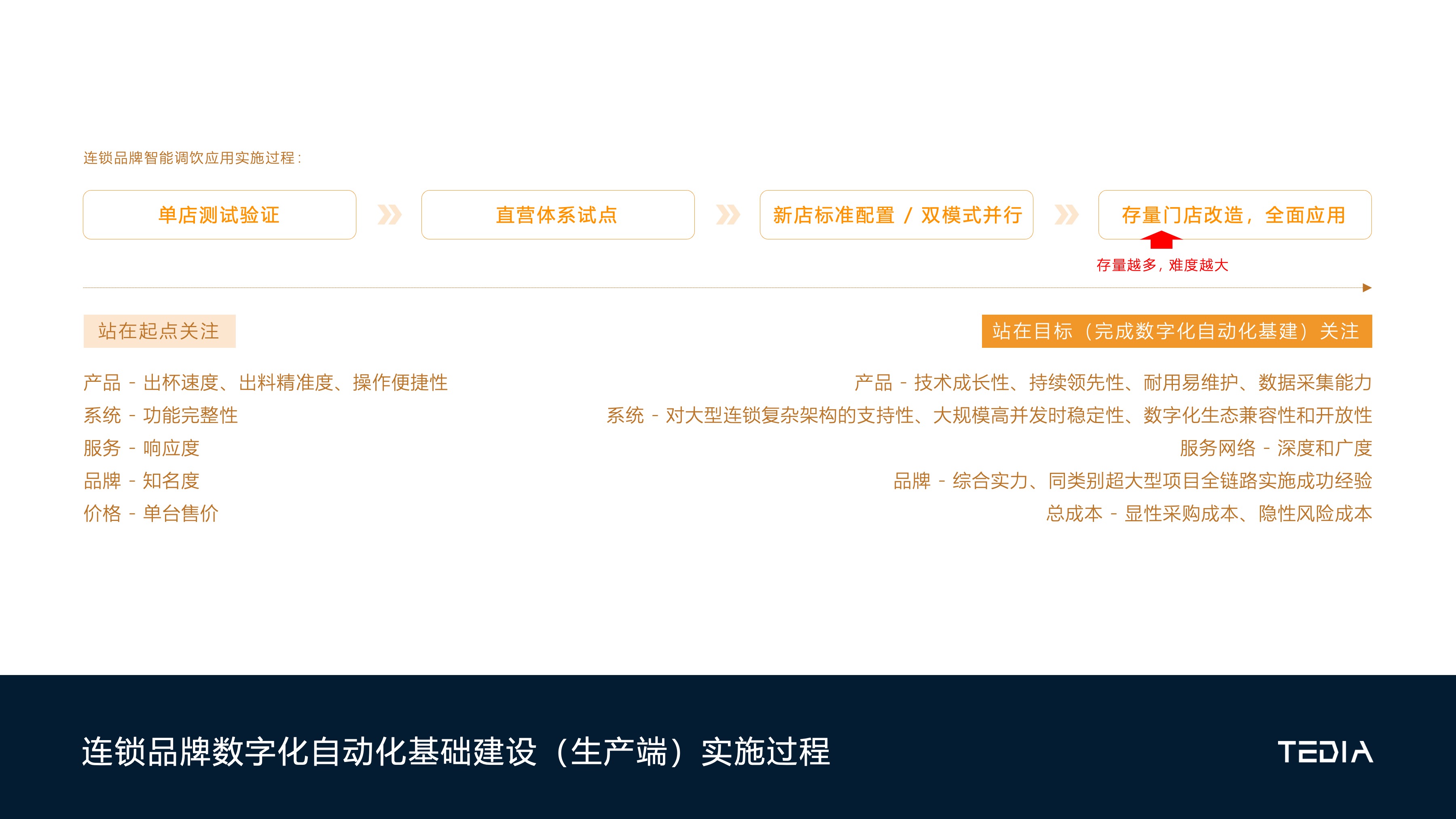
For chain brands, intelligent upgrading is not a simple equipment purchase, but a strategic decision to lay the foundation for thousands of stores. Brands must move beyond short-term perspectives focused on unit price or basic performance, and instead evaluate solutions with the ultimate goal of completing production-side automated and digital infrastructure. This requires a holistic assessment across multiple dimensions:
- Product Capability: Beyond visible metrics such as output speed and ease of operation, brands must evaluate structured data generation and technological scalability—whether atomic-level data on ingredient consumption and equipment status can be captured to support future supply chain forecasting and decision optimization.
- System Architecture: The ability to support complex, large-scale chain organizations, including regional data isolation, high-concurrency order elasticity, and open API ecosystem compatibility, is critical to avoiding costly system reengineering during expansion.
- Service Network: Providers must offer deep, end-to-end service coverage for both existing store retrofits and standardized new-store deployments. Global brands should further assess cross-border technical responsiveness and compliance support.
- Proven Brand Practice: Full-chain implementation experience in large-scale, same-category projects is essential—validated from single-store pilots through to tens of thousands of stores operating in unison.
- Total Cost of Ownership: Evaluation must go beyond unit pricing to account for hidden risk costs—secondary investments due to system scalability limits, data silos from closed architectures, and downtime losses caused by service gaps. Over time, these costs far exceed initial procurement price differences.
Only when decisions are anchored in infrastructure completion rather than short-term needs can brands avoid costly trial-and-error and truly transform production methods into measurable, evolvable, and replicable growth engines.
With an “end-in-mind” philosophy, TEDIA consistently aligns its solutions with the ultimate objective of automated and digital infrastructure, delivering intelligent beverage best practices that combine automation tools with brand-owned data assets.
From Startup Launch to Global Tens of Thousands of Stores:
TEDIA Offers Scalable Solutions at Every Stage—
Empowering Brands to Become Data-Driven Intelligent Entities
With average dispensing deviation < 1 g / 1% and output speeds of 5–15 seconds per cup (depending on volume and sugar viscosity), TEDIA systems dramatically improve store efficiency while ensuring consistently high-quality beverages. At the same time, they generate and synchronously record over 100 structured data points per cup. To support enterprises at different growth stages, TEDIA has built a tiered data service matrix.
For early-stage brands without in-house AI or algorithm teams, production data collected by TEDIA equipment can be combined with domain expertise to establish effective preliminary parametric models. Through the TEDIA APCP system, brands can easily access visual dashboards showing daily cup volume, ingredient usage, and other store-critical operational metrics, or receive consolidated multi-store reports via email for foundational operational insights. By embedding a data-driven mindset from day one, emerging brands lay the evolutionary groundwork for deeper AI adoption—transitioning from experience-based operations to intelligent decision-making.
Mid- to large-scale brands equipped with BI platforms can integrate TEDIA’s structured data via APIs, merging it with multi-source datasets for advanced analytics, AI model training, and scientifically grounded decision-making.
Full-Scenario Coverage:
A Multi-Dimensional Product Matrix for Diverse Needs
TEDIA’s multi-layered product architecture precisely addresses the diverse scenarios of the broader foodservice chain ecosystem. Through intelligent beverage equipment, ingredient supply chains, and value-added services,
TEDIA achieves deep, comprehensive integration into the freshly made beverage landscape.
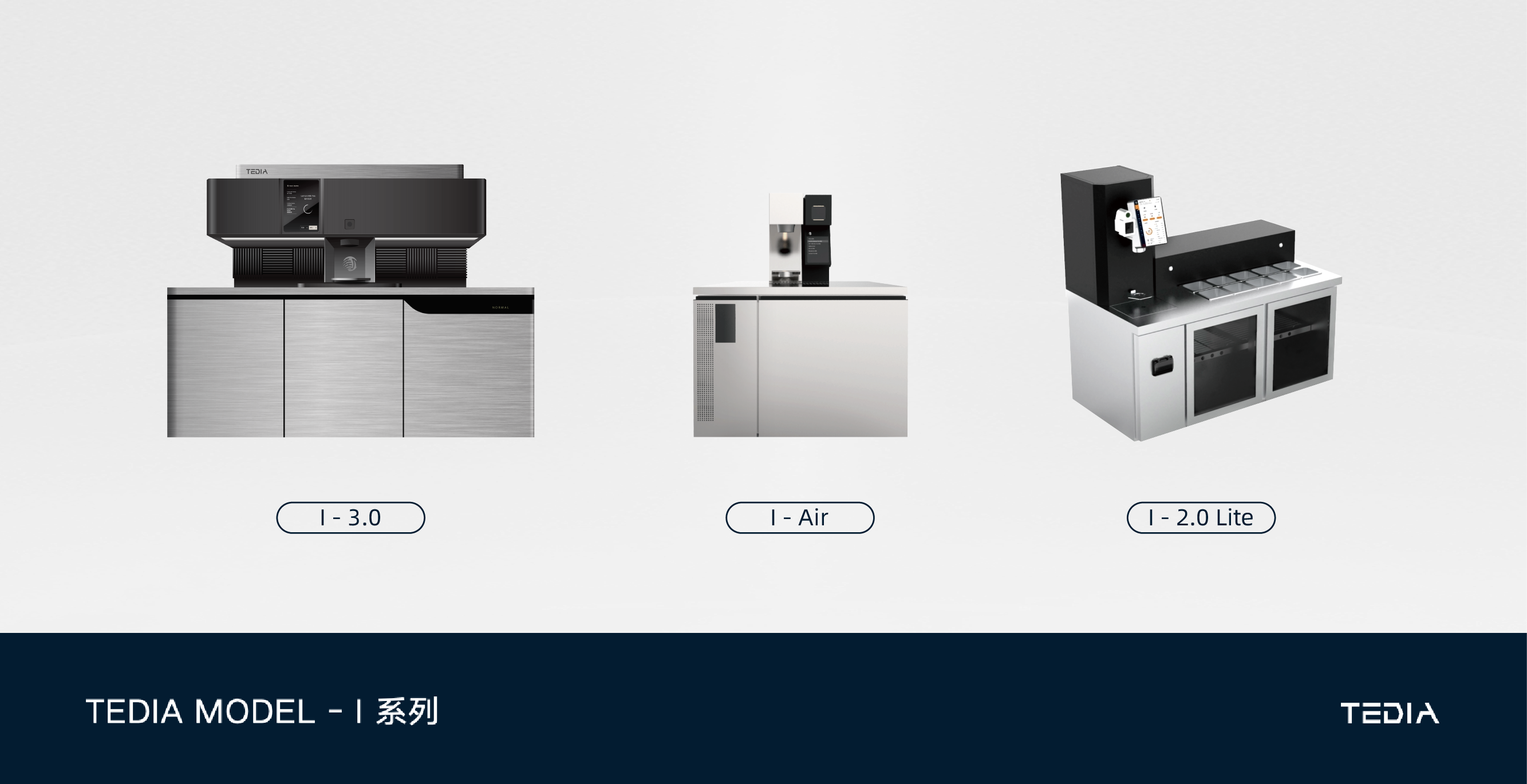
TEDIA MODEL-I3.0, powered by patented weighing-feedback dispensing technology, delivers material control accuracy of < 1 g / 1%, supports up to 64 ingredient hoppers, and achieves a single-machine daily capacity exceeding 5,000 cups—providing stable, high-efficiency output for professional tea and dairy beverage chains.
TEDIA MODEL-I2.0 LITE offers a balanced, cost-effective option for brands seeking optimal value. While retaining core standardization capabilities, it lowers the entry threshold to accommodate diverse store formats—allowing brands to enjoy automated, high-quality output and data system benefits with controlled investment.
TEDIA MODEL-IAir is designed for chains offering both tea and coffee, enabling flexible multi-category operations.
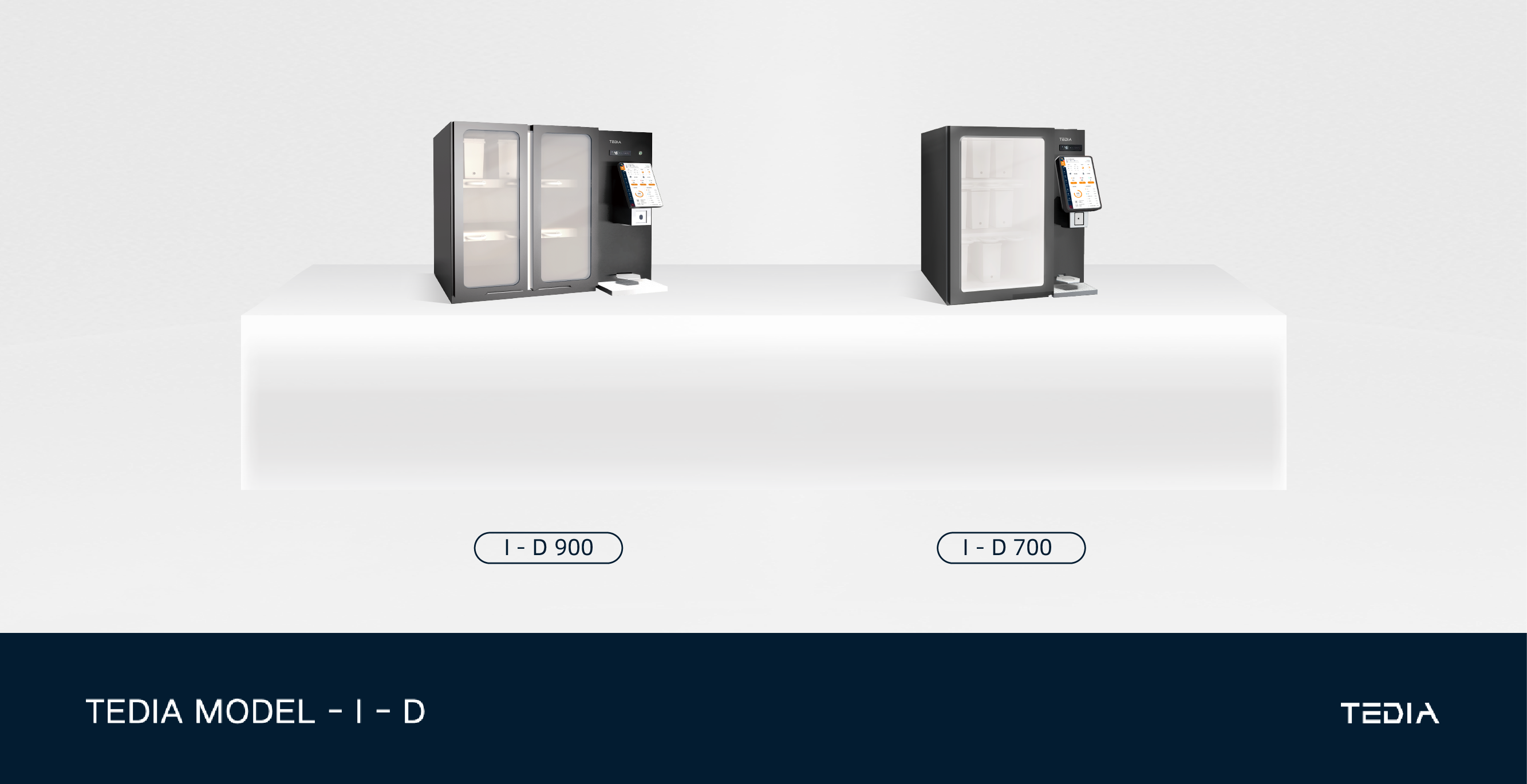
For restaurants, convenience stores, bakeries, and other foodservice formats that treat freshly made beverages as a complementary offering, the MODEL-ID 750 desktop solution demonstrates exceptional adaptability. Integrating the entire beverage production process within a 0.52 m³ footprint, its 9 ingredient hoppers support one-touch production of popular categories such as milk tea, fruit tea, and yogurt-based beverages. Headquarters can centrally deploy recipes via the cloud, enabling QR-scan dispensing where “every staff member becomes a beverage specialist.” Freshly made beverages can be launched rapidly to complement core food offerings, effectively boosting average order value and customer retention.
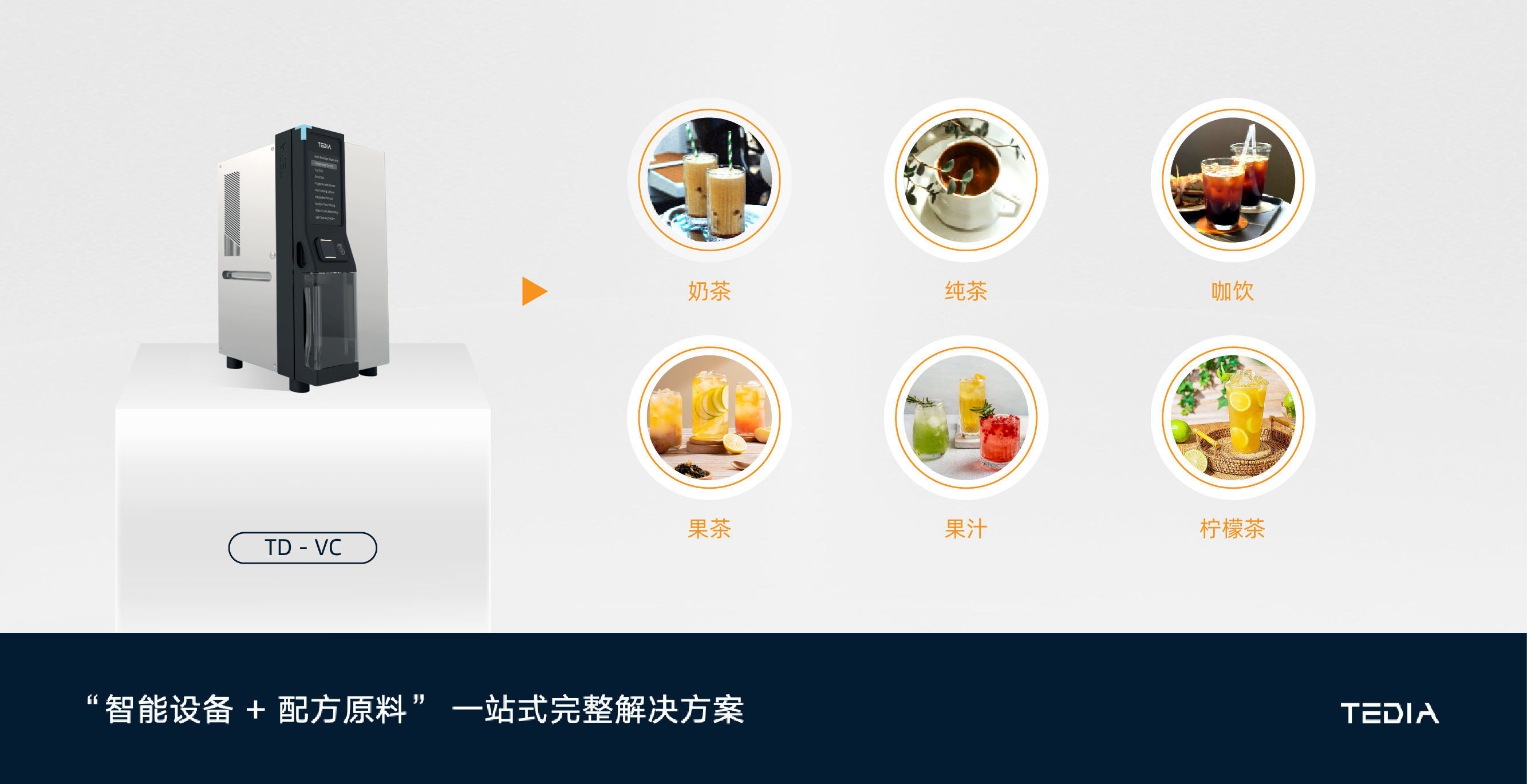
The TEDIA MODEL-VC provides a one-stop solution combining intelligent equipment and standardized ingredient formulas, offering a low-barrier entry point for cross-sector food and retail operators. Restaurants, bakeries, and convenience stores with no prior beverage expertise can quickly go live, while integrated ingredient supply chain services reduce procurement and operational burdens—allowing clients to focus on their core business while capturing growth opportunities in the freshly made beverage market.
When every gram of brewed tea and every minute of machine operation is transformed into quantifiable, optimizable, and predictable decision units, freshly made beverage chains truly gain the key to scalable growth, refined operations, and stable upgrading. TEDIA Technology warmly invites you to connect and explore how your brand can efficiently complete the leap from standardized output to data-driven operations—and unlock the next stage of intelligent growth together.



 返回
返回